
She’s well into a high-earning career. He’s spent years building a business that’s finally coming into its own. Together, they’re growing wealth they hope will fund a comfortable retirement (with a few weeks cruising the Mediterranean each summer) and give their kids something to build on. They have maxed out their 401(k)s and own a home that’s grown in value. But nearly everything they own is tied to the stock market or the roof over their heads, and they’re starting to wonder what else belongs in their portfolio.
At this stage, many successful individuals and families turn to commercial real estate. It can offer the potential for steady cash flow, less exposure to the stock market, and the tangibility of owning something you can drive past. But the traditional routes have drawbacks. Publicly traded REITs rise and fall with the market, and owning rentals directly means handling the upkeep yourself. Syndicated real estate investing offers a middle path, combining many of the benefits of private ownership with the hands-off convenience of professional management.
Advantages of Real Estate
Three ways real estate builds long-term wealth
Ongoing income
Stabilized properties can generate regular cash flow. The amount depends on occupancy, operating expenses, and financing costs.
Inflation hedge
Over long periods, rents and property values have often risen with inflation, which can help preserve purchasing power, although that relationship is not guaranteed.
Tax advantages
Depending on an investor’s tax situation, depreciation, deductible expenses, and strategies like 1031 exchanges can reduce taxable income or defer capital gains.
What is Syndication?
Syndication is a way for investors to combine their capital to buy a larger property, such as an apartment complex or office building. A sponsor (or general partner) identifies the property, arranges financing, manages it, and decides when to sell. The investors, called limited partners, typically receive a share of the property’s income during the hold period and a share of the profits on sale. The sponsor earns fees and a portion of the profits for their effort and expertise.
How profits are shared
Every syndication spells out, in its operating agreement, how cash flow and sale proceeds are divided between investors and the sponsor. The structure varies from deal to deal, so it is one of the most important terms to understand before investing.
Some deals use a straight split. Investors and the sponsor share distributions in proportion to their ownership, and the sponsor is compensated through fees and its own invested capital. This approach is simple to follow, and the sponsor’s results rise and fall with the investors’.
Other deals use a distribution waterfall, a set of tiers that determines who is paid and in what order. Investors typically receive their original investment back first, often along with a preferred return, a set annual rate paid before the sponsor shares in profits. A preferred return is paid only when the property generates sufficient cash and is not guaranteed. Once those tiers are met, the remaining profits are split according to a set ratio.
Whatever the structure, the goal is the same: aligning the sponsor’s interests with those of investors. Each offering’s documents describe exactly how distributions work for that deal.

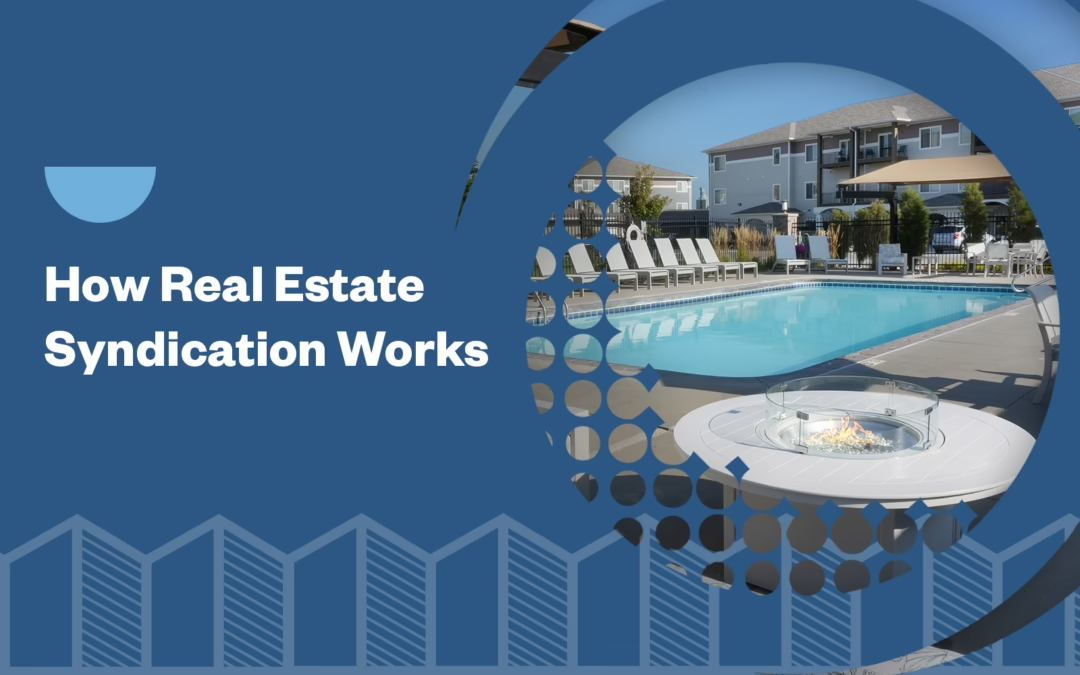
The Oaks at Lakeview, in Ralston, NE. Metonic acquired The Oaks at Lakeview in 2024 alongside a group of syndicated investors.
Advantages of Syndication
- Professional management. An experienced sponsor handles acquisition, financing, operations, and the eventual sale, leveraging expertise most individual investors do not have access to.
- Passive income potential. Investors can receive regular distributions from a property’s income without managing tenants, repairs, or day-to-day operations.
- Tax advantages. Depreciation deductions can pass through to investors and can offset some or all of their distributions for tax purposes.
- Growth potential. Many syndications target properties where the sponsor can raise value through renovations or better management, creating the potential for profit when the property sells.
- An experienced sponsor’s reputation. A sponsor with a proven track record brings advantages individual investors can’t easily access on their own, including off-market deals and better financing. Speaking at the 2026 Metonic Multifamily Investment Forum, Jeff Witt, VP of Debt and Structured Finance at Colliers, remarked that sponsors “that have history and experience and properties in market are going to receive much better debt terms than perhaps a group with less experience.”
Challenges of Syndication
- Illiquidity. Capital is typically locked up for several years until the property sells, with few options to exit early.
- Limited investor control. The passive structure that relieves investors of day-to-day management also removes them from decision-making. Acquisition, financing, operations, and the timing of a sale rest with the sponsor, making the sponsor’s experience and track record a critical factor in evaluating any opportunity.
- Risk of loss. As with any real estate investment, returns aren’t guaranteed, and it is possible for an investor to lose some or all invested capital.
- Fees. As with most forms of real estate ownership, syndications carry costs that reduce net returns. Property management, asset management, and sponsor promote structures are typically paid from property operations or sale proceeds, so it is important to understand how a sponsor’s fees are structured and when they are earned.
- Exclusive access and nuanced tax treatment. Most syndications are open only to accredited investors and require meaningful minimum investments. Tax reporting typically comes through a Schedule K-1 rather than a 1099, which can add a layer of nuance.
Syndication, Direct Ownership, and Public REITs
Direct ownership, syndication, and REITs each have their place, depending on an investor’s goals, budget, and desired level of involvement.
Direct Ownership
Syndication
Public REIT
Investor Involvement
High
The investor is ultimately responsible for upkeep and operations
Passive
Passive after initial due diligence
Passive
Buy and hold shares
Depreciation Tax Advantages
Yes
Depreciation offsets rental income, but usually not wages for high earners
Yes
Depreciation passes through on a K-1 and can offset distributions
No
No depreciation pass-through
Concentration Risk
High
One vacancy can significantly impact cash flow
Medium
Risk is spread across many units, but often concentrated in one property or market
Low
Risk is spread across many properties and often many markets
Liability
Varies
Direct owners may be personally liable for property debts or lawsuits
Limited
Investors generally risk only what they invest
Limited
Investors risk only what they invest
Liquidity
Low
A sale can take months
Low
Capital is typically held for several years
High
Investors can sell shares on any trading day